Australia is famed for its UNESCO World-Heritage sites –the Daintree Rainforest, The Great Barrier Reef and The Sydney Opera House–as well as its unique wildlife: koalas, Nemos, kangaroos and crocs. On this educational student tour you see them all! From Sydney’s city streets to stunning surfing beaches to tumbling rainforest waterfalls, you experience the best of Australia’s grand landscapes and friendly people. Milk the cows and crack whips with genuine Aussie “jackaroos” (cowboys) on an outback cattle station, then learn about medicinal plants with Aboriginal guides, followed by a marine biologist who explains how to find the whole cast of Finding Nemo at the Great Barrier Reef.
for 15 or more students (Add $50 per person for peak time of 15 June – 15 July)
for 10-14 students (Add $50 per person for peak time of 15 June – 15 July)


Details
- See the World-Famous Sydney Opera House
- Enjoy authentic interaction with Aboriginal Guides
- Spend the Night in the Emerald Daintree Rainforest
- Snorkel or SCUBA Dive at the Outer Great Barrier Reef
- Slide Down a Natural Rainforest Waterslide
- Ascend the Pylon of Sydney’s Harbour Bridge
- Glide Over the Rainforest Canopy on the Skyrail
- Optional Community Service Project
- Cuddle a Koala and Feed Kangaroos
- Enjoy an Aussie BBQ and bonfire at an Outback Cattle Station
15+ students: $3328 per person (inc GST)
10-14 students: $3373 per person (inc GST)
Includes:
- Risk assessment
- Cairns and Sydney airport transfers
- Small World Journeys guide Days 1, 2, 4, 5, 6, and 7
- Specialty guides and educators
- All activities and entrance fees as described in the itinerary
- Transportation to activities
- 2 nights Sydney hostel (4 or 6 share dorm rooms)
- 4 nights at Cairns 3-star hotel (2, 3 or 4 share rooms)
- 1 night outback cattle station (single gender dorm-style bunk houses)
- 1 night Daintree Rainforest cabins (3 or 4 or 5 share rooms)
- All breakfasts
- 5 lunches
- 7 dinners
- 101 Animals of the Great Barrier Reef field guide for each student
- Mask, fins, snorkel, wetsuit hire on the reef trip
- Reusable water bottle and cloth shopping bag
- Donation made to Reef Restoration Foundation to the “Care for Coral” program on behalf of your group (we give you a certificate on your trip)
- NEW: we offset the carbon emissions from your trip activities AND your flight to Cairns through Reforest
*Two teacher rooms (private twin or triple share rooms) in Sydney, Cairns and the Daintree Rainforest (at cattle station, teachers get twin rooms with shared bathrooms) are included in the trip price for groups of 15 students or more. For trips with low numbers (10-14), one teacher room is included. A supplement is charged if an additional private room is required for the trip. If teachers are happy to share a room, no additional costs are incurred.
Small World Journeys reserves the right to change the order of activities for logistical reasons.
Prices are valid for travel until 31 March, 2026 outside of peak travel times.
Peak times: 1-7 April | 21 June – 13 July | 19 September – 6 October 2026
- International and domestic airfare
- Travel insurance (highly recommended)
- Three lunches and one dinner
- Personal expenses (souvenirs, laundry, etc.)
- Rides at Sydney’s Luna Park ($75 ofr unlimited rides pass)
- Optional surfing lesson ($140 AUD)
- Photo with koala ($28 AUD)
- Intro or certified SCUBA diving (ask for pricing)
- Community Service Project: Creating hygiene packs for Cairns’ homeless population (1 hour, add $20 per person)
- 1 x day room upon arrival in Sydney to freshen up if you have an early morning arrival (ask us for pricing)
Planning Your Trip
ACCESSIBILITY MENU: Small World Journeys’ website provides an accessibility menu. Visitors to our website can click on the “person” icon on the right side of the screen to bring up this menu. Options include increasing/decreasing font size, increasing/decreasing contrast, dyslexia-friendly fonts, and the ability to hide images, among other things.
BOOKING FORM: On our online booking form, we ask all participants to list any special needs they have, be them medical, dietary, or accessibility needs. We also offer free sensory packs to our guests who are neurodivergent, which include headphones, a timer for transitions, a squeezy fidget toy, and other treats to appeal to the senses like flavoured lip balm.
WAIVER FORMS: We understand that not all of our participants’ parents have a strong command of written English and therefore understanding and signing our on-line waiver may prove challenging. We therefore have our wavier form available in the following languages on request: Chinese, French, German, Italian, Japanese, Portuguese and Spanish.
Arrival & Departure at Sydney Airport
ACCESSIBLE TOILETS & DRINKING FOUNTAINS: Public toilets are located throughout the terminals. Each toilet facility includes an accessible toilet suitable for wheelchair access. View or download our terminal maps to view their locations. Wheelchair accessible drinking fountains are located throughout the terminals.
Google Maps Indoor Live View is now available at Sydney Airport. Indoor maps is a new augmented reality feature on Google Maps – available in both international and domestic terminals – designed to help passengers find gates, baggage claims, retail outlets, dining options, restrooms, ATMs and more.
For any wheelchair or accessibility passengers, please select the ‘Wheelchair accessible’ preference to find wheelchair, pram and suitcase friendly paths. You can also turn on audio navigation prompts, in addition to visual cues.
TGSI and HEARING LOOPS: The Sydney Airport makes use of Tactile Ground Service Indicators (TGSI) and Hearing Loops to assist people with vision impairments and hearing difficulties, respectively. For example, tactile ground surface indicators are also used within the terminal to provide people who are visually impaired, indication of changes of surface conditions. Look for the International Symbol, which is used to indicate that a hearing loop has been installed. More information about hearing loops can be found here.
If you are a blind or low visibility traveller, you can use a free service to help you navigate your way through Sydney Airport’s International and Domestic terminals. Please visit the Aira website to find out more.
If you are deaf, or have a hearing or speech impairment, you can contact Sydney Airport via the National Relay Service. Provide the NRS with the Sydney Airport Customer Care number, 133 793.
ASSISTANCE ANIMALS: Assistance animal toilet and watering facilities are available at the T1 International terminal after security on the arrivals level. A temporary animal relief facility is now open at T2, located on arrivals level, opposite baggage reclaim carousel 2.
HIDDEN DISABILITIES: Wearing a sunflower lanyard at Sydney Airport enables staff to recognise that you have a hidden disability. If you would like to identify your hidden disability, you can pick up a hidden disabilities lanyard at one of the following locations:
- The Airport Services Centre located on Level 3 (Administration) at T1 International terminal
- The Ambassadors information desk on Arrivals level at T2 Domestic terminal
- The oversized luggage counter on Departures level at T3 Domestic terminal
At security screening and passport control this lets staff know that you may need more time and support through processes. Where possible, staff will facilitate you through the special assistance lanes. Note this lanyard does not give you fast track access through security or passport control.
Arrival & Departure at Cairns Airport
ACCESSIBLE TOILETS: Public toilets are located throughout the terminals. Each toilet facility includes an accessible toilet suitable for wheelchair access.
TGSI and HEARING LOOPS: The Cairns Airport makes use of Tactile Ground Service Indicators (TGSI) and Hearing Loops to assist people with vision impairments and hearing difficulties, respectively. For example, Braille is included on toilet doors/signs to assist a person with vision impairment locate the correct facility.
ASSISTANCE FOR HIDDEN DISABILITIES: If you or someone you are travelling with has a hidden disability, you can request a hidden disability lanyard through a form here. Wearing a sunflower lanyard when you are at Cairns Airport is a discreet way for you to indicate to the airport team that you may need a little extra help, guidance or time with the airport processes. The airport team has been trained to recognise the lanyard and provide the assistance and support you may need. Some of the airport staff will also be wearing a Sunflower badge on their shirts or lanyards to help you feel a little more at ease.
VISUAL AND WRITTEN STORY GUIDES: Visual Story Guides are available for Domestic Arrivals and have been designed to help you to understand how an airport works and what to expect. Written Story Guides are also available for Domestic Arrivals. Visual Story Guides are available for Domestic Departures and have been designed to help you to understand how an airport works and what to expect. Written Story Guides are also available for Domestic Departures.
Our Safety Talks
Our arrival safety talk is done verbally but is supported by cards that illustrate the main talking points. Similarly, our snorkelling safety talk is done in the same manner, supported by cards with pictures and illustrations.
We can provide a transcript of our safety talk to any hearing-impaired guest.
Transport
For Sydney, please let us know in the planning phase of your trip if you have a member of your group using a wheelchair or mobility device and we can arrange for accessible transport options.
In Cairns, our buses have two steps up of approximately 40 cms to get inside. There is no lift for a wheelchair or mobility device. Similarly, on occasion we hire large coaches for bigger groups and those buses also have two steps up of about 40 cms to get inside. All buses are equipped with seatbelts.

Presentations & Workshops
OUR OFFICE & PRESENTATION SPACE: In Cairns we use the Small World Journeys office space for presentations, workshops and some community service projects. There is a rise of approximately 2 cm to enter the presentation room. We have one accessible, gender-neutral toilet block with shower.
The presentation room is equipped with chairs, and chairs with armrests are available on request for guests who may benefit from additional support when sitting down or standing up.
In the outside area of our office, planes fly overhead frequently and the noise can be startling and confronting. However, as part of the terms of construction, the entire building has sound mitigation devices (double glazed windows, etc.) which creates the opportunity for multiple breakout spaces for neuro-divergent people who desire a quiet space with reduced stimuli.
Our presentations are designed to appeal to both visual and auditory learners. We can provide a transcript of our presentations to any hearing-impaired guest.
NOVOTEL PRESENTATION SPACE: In Cairns we also use Novotel Cairns Oasis Resort for presentations at dinnertime.
Overall accessible resort information:
- All entries to the hotel are wheelchair-accessible
- 2 accessible spaces in the on-site car park, near lifts
- 1 accessible toilet in hotel lobby (hand rail | grab bar)
- Most walkways within the hotel are wheelchair-accessible
- Well-lit main areas
- All meeting rooms are accessible
- Braille call buttons for lifts on each floor (external)
- On-site restaurant & breakfast buffet is mostly accessible – Please ask for assistance at hot food station.
Hotels
FLEXIBILITY WITH ACCOMMODATION: We have flexibility with the accommodation we choose; therefore if we know in advance that we have a guest with a wheelchair, mobility scooter or is short statured, we can choose hotels that cater accordingly.
PREFERRED HOTEL (SYDNEY): The entire property is accessible for wheelchair and mobility device users. There are accessible rooms as well: the shower is a roll-in shower with a flip-down shower bench. The accessible accommodation is suitable for up to three people. There are lifts in the building to get to rooms and to street level. There are spots on site where a person who is neurodivergent could find a quiet space with reduced stimuli or retreat to his/her room.


PREFERRED HOTEL 1 (CAIRNS): One of our preferred Cairns hotels is centrally located and one block from the waterfront. The reception and breakfast room are widely accessible through a double automatic door as there are no steps or thresholds. Accessible guest rooms are all on the ground level. The staff are happy to move the furniture around if required, and the rooms are fitted with a zipped-together queen bed or two single beds depending on preference. The under-bed clearance is 40mm, and there’s around 1000mm of space between the side of the bed and the wall. Unfortunately, the balconies have sliding door tracks and may not be completely accessible. Light switches are all large dish-style type and located 1000mm from the floor in accessible locations. The air conditioning can be remotely controlled. Moving into the bathroom: the hotel boasts accessible showers and toilets that are hobless and fitted with a fold-down seat. Both horizontal and vertical grab rails are fitted and the shower is home to a hot and cold flick mixer tap. The lifts which provide access to the third accessible room provide ample space for wheelchairs, and also boast buttons fitted with Braille.

PREFERRED HOTEL 2 (CAIRNS): A second preferred hotel is also centrally located. With accessible rooms that boast a double bed and a single bed, the staff at the hotel are also happy to move the room furniture around to suit guests who use a wheelchair or mobility device. With a coffee and tea making space and a small bar fridge at hand, the TV can also be controlled by the remote. It’s worth noting that at this hotel the air conditioning unit cannot be operated by a remote. There is an accessible combined toilet and shower facility fitted with grab rails and a fold-down set. The shower is also hobless for added accessibility. Unfortunately, the balconies have sliding door tracks and may not be accessible to all guests, and there are also no designated accessible parking bays. However, there is ample room for drop offs immediately in front of reception.
Entering the reception may also be a little difficult as the door is manual, but staff are always happy to assist (and man the desk 24 hours). There are wide paths that lead from the reception to every area of the resort, including the BBQ area, the pool and the adjoining dining room.

 PREFERRED HOTEL (DAINTREE): Wheelchair users will be pleasantly surprised by how accessible the property is. The two Escape Cabins are especially convenient. There are no lifts to these two cabins, no stairs, the room is large and the light switches are low. The bathrooms is suitable for wheelchair access. There are spots on site where a person who is neurodivergent could find a quiet space with reduced stimuli or retreat to his/her room.
Meals & Restaurants
FLEXIBILITY WITH RESTAURANTS & CATERING: We have quite a bit of flexibility with the restaurants we choose; therefore if we know in advance that we have a guest with a wheelchair, mobility scooter or is short statured, we can choose restaurants that cater accordingly.
We offer flexible menu options for people who have food allergies or intolerances, and in many cases religious requirements relating to food.
Guests are given space on our online booking form to specify their allergy, intolerance or religious requirement. On arrival we then give them a bag containing, for example, lactose-free milk, nut-free cereal and snacks, and/or other food items that cater to this allergy or intolerance. Unfortunately, we are not able to guarantee catering for preferences like low carb meals or FODMAP.
Similarly, we inform all caterers and restaurants of our guests’ food allergies or intolerances. Breakfast is typically served at the hotel, whilst lunches are often boxed lunches as we move around quite a bit on our tours.
Activities
If we are informed in the planning phase of your trip about any participants or (potential participants) who have disabilities or special needs, we can suggest certain activities over others or suggest certain boats to the reef. For example, one boat that travels to the reef has a lift for a guest in a wheelchair to get in and out of the water which is a great choice for guests with wheelchairs or mobility devices. Conversely, we know that the facilities on the boat that travels to the Fitzroy Island reef is not well set up for those with wheelchairs or mobility devices. We also can include activities such as the Skyrail Rainforest Cableway, which recognises and supports the Sunflower program for people with hidden disabilities.
On this particular trip, there are quite a few activities:
Sydney Harbour Bridge Pylon Climb:
To participate you need to have a general level of health and fitness, and the ability to climb independently. At the pylon, they have a variety of headsets available and many hearing impaired climbers have agreed that these allowed them to enjoy the commentary delivered by their Climb Leader. They also offer Auslan Climbs. On an Auslan Climb you’ll be accompanied by an Australian Sign Language interpreter who will interpret the commentary about Sydney and its world famous Bridge. These Climbs occur twice a month. Many people with vision impairment have climbed the bridge pylon. There are no spots on site where a person who is neurodivergent could find a quiet space with reduced stimuli.
Barangaroo Walk with Indigenous Guide
Wulugul Walk, which follows the 1836 foreshore, is relatively level and, like all dedicated pedestrian pathways in the Reserve is 3.8m wide. At the northern end, Wulugul Walk provides stair-free access to the Waranara Terrace and the Stargazer Lawn for wheelchair or mobility device users. The Indigenous guide delivers his/her talk verbally, so there are not provisions made for those with hearing impairments. There are some spots on site where a person who is neurodivergent could find a quiet space with reduced stimuli.
Sydney Harbour Ferry
Wheelchair accessible wharves have level or ramped access that allows independent access by a person using a manual wheelchair or walking aid. The accessibility at Circular Quay, Cremorne Point and Neutral Bay changes at low tide. Assisted access may be required. Gangway and Ramp gradients are tide dependent. All ferries have toilet facilities including at least one wheelchair accessible toilet. There no spots on the boat where a person who is neurodivergent could find a quiet space with reduced stimuli.
Sydney Observatory
As a heritage site Sydney Observatory has some accessibility limitations. Visitors requiring wheelchair access can experience Sydney Observatory gardens and the ground floor of the Astronomer’s Residence. There is no wheelchair access to locations visited during Sydney Observatory Tours or Family Tours due to narrow and steep staircases in the heritage-listed buildings. There are some spots on site where a person who is neurodivergent could find a quiet space with reduced stimuli. Sydney Observatory has adopted the Hidden Disabilities Sunflower to help support and raise awareness of those living with a hidden disability.
Wooroonooran National Park: Josephine Falls
The toilets, picnic shelter and picnic tables in the car park area are wheelchair and mobility device-accessible. Wheelchair and mobility device access is available to the viewing platform at the top area. Stairs lead to the bottom pool where swimming takes place. People with hearing impairments can read the interpretive panels at the falls. There is a spot on site where a person who is neurodivergent could find a quiet space with reduced stimuli.
Millaa Millaa Falls
Millaa Millaa Falls in the lower carpark at the base of the falls which has an accessible viewing platform nearby. There is no access to the swimming area at the falls, with no provisions for people who use a wheelchair or mobility device. There are accessible toilets adjacent to the car park. There is a spot on site where a person who is neurodivergent could find a quiet space with reduced stimuli. People with hearing impairments can read the interpretive panels at the falls.
Outback Cattle Station
The property has an accessible toilet and shower. Bunk houses are suitable for people using a wheelchair or a mobility device. Eating area is located on a rock & slate surface, which is relatively smooth but slightly uneven in some places. The pioneer homestead and the hay truck (for wildlife viewing on the property) is not accessible for people using a wheelchair or a mobility device. There are many places on site where a person who is neurodivergent could find a quiet space with reduced stimuli. People with hearing impairments can receive safety instructions for cow milking, boomerang throwing and other activities in a visual format. People with vision impairments can receive verbal safety instructions for cow milking and other activities in a visual format, however boomerang throwing is not recommended.
Hunting & Gathering with Indigenous Guide
This activity does not cater for people with access needs and there are no accessible toilets nearby. There are a spot on site where a person who is neurodivergent could find a quiet space with reduced stimuli. People with hearing impairments are not well catered for during this activity and those with vision impairments will be assisted by our guide.
Wildlife Park
The park is about 98% fully accessible for wheelchair and mobility device users. Wheelchairs are available free of charge from Admissions (need to be pre-booked). The pathways to Gondwana Gateway and Cassowary Walk are moderately steep and assistance may be required. The only area not suitable for a person in a wheelchair is the Crocodile Farm Tour as they cannot see into the pens; however they can still listen to the information given on croc farming. Ambulant access toilets are located at Lilies Restaurant and at our Gallery of Living Art. People with hearing impairments can read the interpretive panels at the different areas of the park. Support dogs for people with vision impairments have limited access to certain area’s i.e.: restaurant, shop and limited croc area, but some areas with wallabies, kangaroos, koalas and birds the dogs are forbidden access; clients CAN leave the dog with us in the air-conditioned office.
The Outer Reef Trip
- Accessible toilet facilities are available on the main deck
- Due to the movement of the tides and the necessity to occasionally move to different decks for embarkation and disembarkation, the boat is not well equipped to accommodate wheelchairs or mobility devices.
- Safety instructions are given verbally (no written instructions available).
- The captain is the first point of call for any questions or queries in regards to accessibility and/or special requirements that guests may have on the day.
- The boat uses pictogram signs (for example a pictogram showing feet standing on coral with a red line through it) to assist people with low literacy levels or who speak English as a second language.
- The distance from the Reef Fleet terminal to the vessel is approximately 150 metres; there is a wheelchair available from our check-in counter to assist with commute from terminal to vessel for distance walking if required.
- Most dietary restrictions (gluten or lactose free, vegan, nut-free) can be accommodated.
- There are limited spots where a person who is neurodivergent could find a quiet space with reduced stimuli on the boat; however once docked the majority of guests are on the pontoon which means a the boat has more quiet space.
Excursion Safety & Compliance Checklist
1. Check Small World Journeys Safety Record
☐ Demonstrated excellent safety record with thousands of high school students – both Australian students and international students
☐ Teacher safety references available on request
☐ Proven experience delivering school excursions and educational tours
2. Risk Management & Documentation
☐ Written risk assessment completed for every excursion
☐ Risk assessment provided to organising teacher prior to departure
☐ Activities governed by documented Standard Operating Procedures (SOPs)
☐ Crisis Management Plan in place and available to schools
☐ Daily risk review conducted by guides during the program
3. Student Safety Briefings
☐ Mandatory student safety briefing delivered during program orientation
☐ Briefing addresses local environmental hazards and regional risks
☐ Clear expectations for student behaviour and group safety
4. Transport Safety
☐ All buses fitted with seatbelts for every passenger
☐ Vehicles exceed Queensland minimum legal requirements
☐ Daily vehicle safety checks conducted by guides
☐ Buses undergo Department of Transport inspections every 12 months
5. Guide Qualifications & Child Safety
☐ All guides hold current Senior First Aid certification
☐ All guides hold current CPR certification
☐ Valid Driver’s Authority held by guides when driving
☐ Valid Working With Children Check (Blue Card)
☐ Guides have undergone thorough background screening
☐ Guides trained in duty of care, code of conduct with teenagers and risk management
6. Supervision & Duty of Care
☐ Appropriate student-to-guide supervision ratios
☐ Teachers supported by experienced trained guides
☐ Clear lines of responsibility for student wellbeing and incident response
7. Compliance Assurance
☐ Program aligns with school excursion policies and approval requirements
☐ Documentation suitable for principal approval and risk review
☐ Ongoing communication with schools before and during the excursion
Itinerary

Arrival:
Welcome to Sydney! On arrival, you are greeted by your knowledgeable local guide, who has an intimate understanding of Sydney’s historic back streets, famous landmarks, and hidden gems. Your guide escorts you to your accommodation and provides a comprehensive orientation, outlining what to expect during your time exploring Australia’s largest and most iconic city.
Central Accommodation:
Your hostel is centrally located in The Rocks, the historic neighbourhood where Sydney was first established. Built above preserved colonial-era archaeological remains, this accommodation blends modern facilities with rich Australian heritage. All rooms feature ensuite bathrooms and air conditioning, while shared facilities include spacious communal areas, internet access, an on-site grocery store, coffee bar, and a large rooftop terrace offering spectacular views of the Sydney Opera House.
City Walking Tour & Opera House:
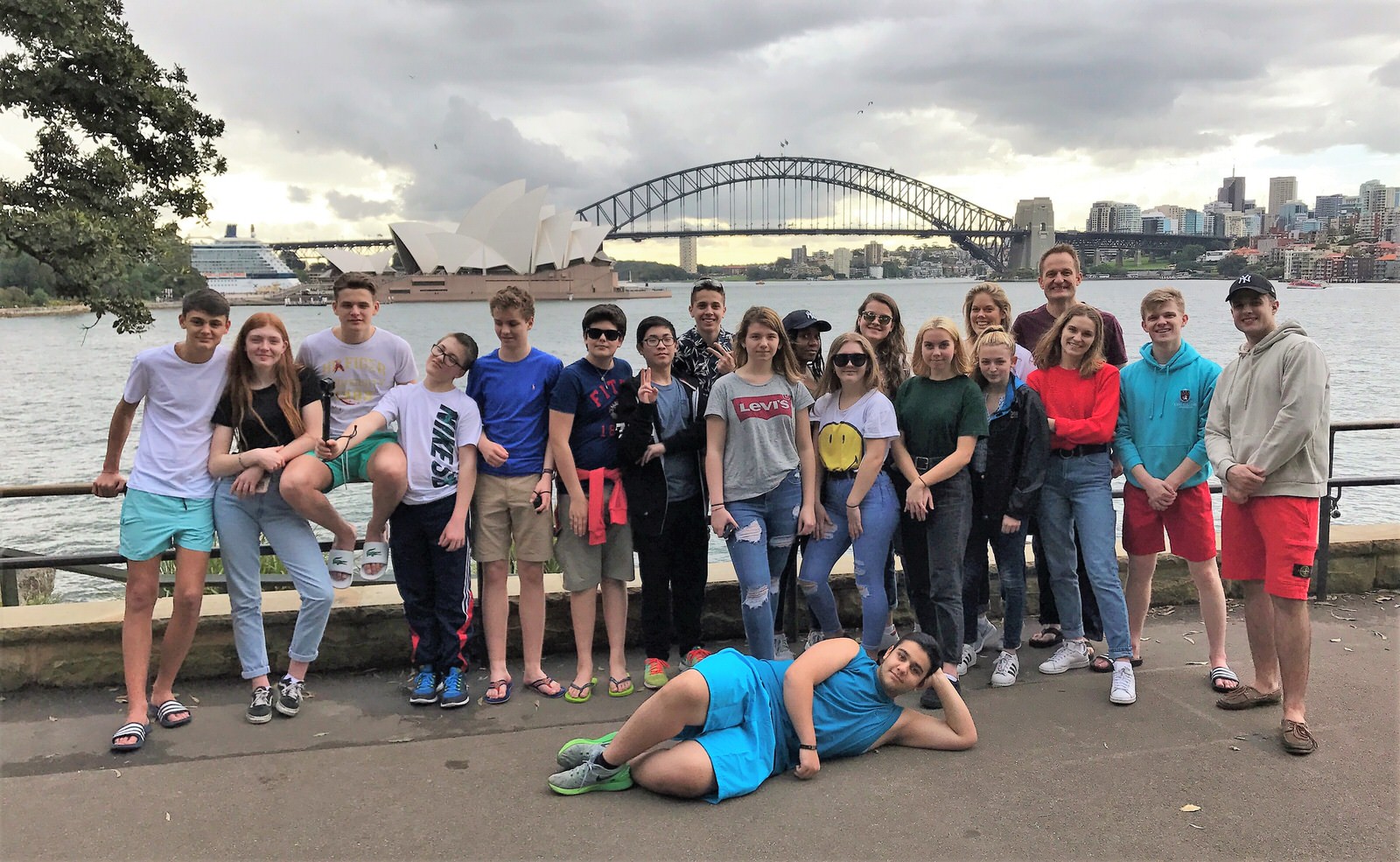
With your guide you explore Sydney on foot, discovering the city’s cultural, historical, and natural highlights as you wander through city streets, cobblestone laneways, and waterfront paths. Your walking tour traces the footsteps of convicts and early colonists, uncovering the colourful and sometimes eerie history of The Rocks. No visit to Sydney is complete without a photo in front of the world-famous Sydney Opera House, followed by a stroll through the Royal Botanic Gardens, where you enjoy one of the city’s most scenic lookout points over the harbour.
Sydney Harbour Bridge Pylon Lookout:
This afternoon you experience another of Sydney’s most recognisable landmarks at the Sydney Harbour Bridge Pylon Lookout. After climbing 200 steps, you pass through interactive exhibits detailing the history and engineering of the bridge and the workers who built it. The experience culminates at a viewing platform 87 metres above sea level, where you are rewarded with panoramic views across Sydney Harbour, the Opera House, and the city skyline.
Accommodation: Sydney Budget Accommodation
Meals Included: Dinner

City Highlights from the Water:
This morning you cruise across the spectacular Sydney Harbour to discover the city’s iconic waterfront landmarks, including Shark Island, Fort Denison, and Darling Harbour. You may choose to stop at Watsons Bay for breathtaking clifftop views in Sydney Harbour National Park, followed by a classic meal at Doyle’s famous fish and chips. Alternatively, you can disembark at Luna Park Sydney, home to the instantly recognisable smiling entrance and historic rides such as The Wild Mouse rollercoaster and the giant Ferris wheel (free entry; rides at own cost).
OPTION: Surfing Lessons at Manly:
You have the option to join surfing lessons at Manly Beach, one of Australia’s most iconic and world-renowned surf beaches. In a small-group lesson, you begin by learning about ocean dynamics, tides, rips, and surf safety, before moving on to paddling techniques, standing skills, and surfing etiquette. Designed for beginners, this lesson gives even first-time surfers the chance to catch a wave. With practice, you’ll be standing and riding waves—an unforgettable highlight and the perfect souvenir of an Australian coastal experience.
Aboriginal Culture in the City:
Later you explore Aboriginal culture in Sydney with an Indigenous guide as you walk through an area once inhabited by clans of the Eora Nation. Your guide shares the Aboriginal history of Sydney Harbour, explaining the cultural significance of this landscape despite its location within the modern city skyline. As you move through this special reserve, you encounter native plants traditionally used by Aboriginal people—for food, medicine, weaving, and everyday life. Through storytelling, your guide brings to life the belief systems, knowledge, and enduring connection to Country that existed for thousands of years before European settlement.
Evening at Sydney Observatory:
In the evening, you visit the Sydney Observatory for an immersive astronomy experience. Wearing 3D glasses, you watch a dynamic space film before entering the planetarium to learn about the night sky, nearby stars, visible dwarf galaxies, and how Aboriginal cultures interpreted the cosmos using negative space in the sky. When conditions allow, you use a powerful telescope to observe star clusters, red giants, and nebulae where stars are forming. If weather limits telescope viewing, an engaging indoor planetarium session ensures the experience remains interactive and inspiring.
Accommodation: Sydney Budget Accommodation
Meals Included: Breakfast, Lunch and Dinner

Flight to Cairns:
Today you are transferred from your Sydney accommodation to the domestic airport for your flight to Cairns (flight not included). On arrival in Cairns, you are met by a Small World Journeys staff member and transferred to your accommodation, marking the start of your Far North Queensland experience.
Educational Presentation:
Next you take part in an interactive educational workshop tailored to your group’s learning objectives and interests. Presentation topics may include Australia’s dangerous animals, biodiversity and the Wet Tropics World Heritage Area, impacts of tourism, or a game-show–style sustainability session designed to engage students while reinforcing key environmental concepts.
Accommodation: Cairns 3-star hotel
Meals Included: Breakfast and Dinner

Today you enter Wooroonooran National Park, a richly diverse section of the Wet Tropics World Heritage Area. This globally significant region protects some of the oldest continually surviving tropical rainforest on Earth, making it a vital area for biodiversity, ecology, and conservation learning.
Josephine Falls:
One of the most picturesque waterfalls in the Wet Tropics, Josephine Falls is reached via an easy rainforest walk through lush jungle. Along the way, you may hear the calls of king parrots and bowerbirds before emerging at the falls, where Josephine Creek cascades over smooth granite rock. At the base, boulders surround a refreshing natural swimming hole, complete with a famous rock waterslide formed by the gently sloping stone.
Millaa Millaa Falls:
Millaa Millaa Falls—meaning “plenty of water” in the local Aboriginal language—is an icon of Tropical North Queensland and one of the region’s most photographed natural landmarks. The waterfall plunges over ancient basalt rock thousands of years old, creating a dramatic curtain of water. A large swimming hole lies at the base of the falls, and you can explore the unique columnar basalt formations, offering a rare perspective from behind the cascade.
Outback Cattle Station:
Next you travel into classic Australian outback country, where kangaroos and dingoes roam freely. You are welcomed as exclusive guests to a working cattle station and homestead, opened only to your group. After a guided station tour, you keep an eye out for wallabies and wild crocodiles, then enjoy a traditional Aussie BBQ dinner followed by a campfire. As night falls, the remote outback setting offers exceptional views of the southern night sky, where constellations shine brightly without light pollution.
Accommodation:
Tonight’s accommodation is in single-gender dorm-style cabins with bunk beds and provided linen. Toilets and hot showers are located in a nearby amenities block, allowing you to experience the outback in comfort while staying close to nature.
Accommodation: Outback Cattle Station
Meals Included: Breakfast, Lunch and Dinner

Cow Milking, Animal Feeding and Whip Cracking:
Breaking into small groups, you experience authentic Australian outback station life through hands-on activities. You feed goats and chickens, learn how to milk cows, and practise traditional whip cracking in classic stockman style. You also step back in time at the historic homestead, exploring the lives of early Australian pioneers as you handle original furniture, tools, and memorabilia carefully preserved by the family.
Boomerang Throwing:
Yes—they really do come back! Your guide explains the cultural significance of the boomerang and how Aboriginal people traditionally used it for hunting and survival. You learn correct throwing techniques and discover the aerodynamics that allow a boomerang to return, combining cultural learning with practical skill-building.
Skyrail Rainforest Cableway:
This afternoon you experience Cairns’ premier eco-attraction, the award-winning Skyrail Rainforest Cableway. Spanning 7.5 kilometres over Barron Gorge National Park, the Skyrail journey offers breathtaking views above World Heritage–listed tropical rainforest. The experience includes stops at two rainforest mid-stations, where you disembark onto elevated boardwalks, take part in guided rainforest walks, and explore interpretive signage and an educational rainforest centre. You return to Cairns later in the afternoon with time to browse the Cairns Night Markets.
Optional Evening Activity – Documentary Film:
Documentary films provide powerful opportunities for reflection, discussion, and action, while reinforcing the environmental themes of your journey. This evening, you may choose to watch one of several environmentally focused documentary films, offering deeper insight into conservation, sustainability, and global environmental issues (no extra cost).
Accommodation: Cairns 3-star hotel
Meals Included: Breakfast, Lunch and Dinner

Wildlife Park:
This morning you visit a wildlife refuge dedicated to Australian native animals, including crocodiles, kangaroos, koalas, and a wide variety of bird species. Set across eight acres, the park features three immersive, open-range environments—the Rainforest, Wetlands, and Grasslands—allowing visitors and animals to interact in a natural, habitat-style setting. Entry fees and donations directly support the park’s Wildlife Rescue Program, which includes a dedicated wildlife care and rehabilitation centre focused on conservation and animal welfare.
Optional Photo – You and a Koala!:
If you’ve always wanted a classic Australian koala photo, this is your opportunity to capture a memorable moment with one of Australia’s most iconic animals (additional cost).
Daintree Rainforest & Eco-Lodge:
Later you travel north into the Daintree Rainforest, home to one of the oldest continually surviving tropical rainforests on Earth, estimated to be around 135 million years old. Your stay is at a rainforest eco-lodge, perfectly positioned within this ancient landscape. Facilities include a swimming pool, guest laundry, BBQ area, and tranquil rainforest surrounds. Students stay in comfortable rainforest cabins with ensuite bathrooms and air conditioning, falling asleep to the sounds of the jungle for a truly immersive Daintree experience.
Accommodation: Daintree Rainforest cabins
Meals Included: Breakfast, Lunch and Dinner

Aboriginal Culture and Food Gathering:
This morning, you walk with two Aboriginal guides from the Kubirri Warra clan along the coastline they have cared for and lived on for thousands of years. Your guides teach you traditional skills such as spear throwing and demonstrate how food is gathered using time-honoured methods—searching for fish, mud crabs, mussels, and other bush tucker along the beach and within the mangrove ecosystems. Along the way, you learn about Country, wildlife, and native plants, including those used for food and traditional medicine. This authentic cultural experience offers meaningful insight into how Indigenous knowledge, culture, and land management practices continue to be integrated into modern life.
Marine Biologist Reef Presentation:
Later you take part in an engaging marine science presentation led by our marine biologist, focusing on biodiversity and the ecological significance of the Great Barrier Reef. You learn to identify common reef species, from vibrant corals shaped like broccoli, brains, and baskets to reef fish such as the chocolate-dipped damsel, Picasso triggerfish, and giant Maori wrasse. The session explores threatened species, coral predators such as the Crown-of-Thorns starfish, and the impacts of climate change and human activity on reef health. Importantly, you also learn to distinguish between real reef hazards—such as the deceptively dangerous cone shell—and the exaggerated dangers often portrayed in popular media. You leave with a deeper understanding of reef ecology, improved species identification skills, and a strong appreciation for the natural wonder you are about to experience first-hand.
Accommodation: Cairns 3-star hotel
Meals Included: Breakfast, Lunch and Dinner

Boat Ride to Reef:
Your day begins with a comfortable, air-conditioned catamaran journey to the outer Great Barrier Reef, a UNESCO World Heritage Site and one of the most biodiverse marine ecosystems on Earth. During the journey, your marine biologist explains what you are likely to encounter on the reef and introduces the Eye on the Reef program, including guidance on how to complete the Rapid Monitoring Survey used to assess reef health.
Snorkelling:
On arrival, you dock at a floating reef pontoon, where a vibrant underwater world awaits. While snorkelling, you can expect to see a spectacular mix of hard and soft corals, sea turtles, and a wide range of reef fish, including butterflyfish, giant Maori wrasse, parrotfish, and the ever-popular clownfish (“Nemo”).
Field Guide:
Each student receives a copy of 101 Animals of the Great Barrier Reef by Dr Martin Cohen, an illustrated reef identification guide that helps deepen understanding of coral reef species. This resource is yours to keep.
Observatory:
The pontoon features an underwater observatory, allowing you to view marine life from below the surface, as well as a marine life touch tank for closer inspection of select species. Floating noodles and life jackets are available to support comfort and safety in the water.
Lunch today is a tropical buffet served on board, providing a relaxed break between reef activities.
Semi-Sub and Glass Bottom Boat:
A semi-submersible vessel and glass-bottom boat offer excellent viewing opportunities for those who prefer not to swim, ensuring everyone can enjoy the marine life of the Great Barrier Reef.
Optional SCUBA Diving:
Snorkellers may also choose to experience introductory SCUBA diving with a qualified instructor. Also known as resort diving, this one-on-one experience allows participants to explore the reef without prior certification (extra cost and medical restrictions apply—see OPTIONS tab).
Slide into the Reef:
You may choose to end the day on a high note by enjoying the pontoon’s unique double-storey waterslide, a fun feature that lets you slide directly into the clear waters of the Great Barrier Reef—a memorable way to celebrate a day of reef exploration.
Accommodation: Cairns 3-star hotel
Meals Included: Breakfast, Lunch and Dinner

After breakfast this morning, you have free time in Cairns for last-minute shopping or souvenir purchases, with easy access to local markets and stores.
Optional Community Service Project:
An important part of being a sustainable and responsible tourist is giving back to the local community. This morning, you have the opportunity to do just that by participating in a community service project in Cairns that supports people travelling from remote Indigenous communities for medical treatment. Often arriving with few personal belongings, these visitors benefit greatly from practical support. Using upcycled materials, you create reusable bags and assemble essential hygiene packs containing items most needed during their stay. No artistic experience is required—the bags are simple to make—and the focus is on empathy, sustainability, and meaningful social impact. (Approximately 1 hour and 15 minutes; available on request, add $20 per person.)
Later, you are transferred to Cairns Airport for your flight home, concluding your Far North Queensland journey.
Meals Included: Breakfast
How Your Trip Makes The World A Better Place
We’re not talking rainbows and unicorns. We’re talking about how we have put significant thought into how to make our student tours as safe as they possibly can be while still being fun; encouraging students to learn about and contribute to the community they are travelling in; and teaching them what “sustainability” really means.

Sustainability
OUR COMMITMENT: We are determined and motivated to be the most sustainable business we can be. This is why we run our office on renewable energy, voluntarily offset our carbon emissions (AND your flights to get to us!), and fulfilling our policy to give at least 5% of our annual net profits to local environmental and community organisations and charities. Here’s what else we are doing:
HELPING THE REEF: For every group that visits the reef, we make a donation to the Reef Restoration Foundation (RRF) to support their "Care for a Coral" program. The coral propagation work led by RRF is groundbreaking and recognised as a major initiative in efforts to help restore the reef. Each group receives a "Care for a Coral" certificate from RRF as a token of our contribution and commitment to reef conservation.
ADOPTING A RAINFOREST PLOT IN YOUR NAME: For each group that visits the rainforest, we contribute to the not-for-profit organisation Reforest to support the planting and nurturing of a tree, helping to regenerate the endangered Mabi rainforest. As part of your excursion, your group will receive a certificate recognising this meaningful gift to the environment.
...
Community
SUPPORTING OUR INDIGENOUS COMMUNITY: It is our policy to include a talk or an activity with an Aboriginal person on every trip we offer. By taking this trip, you are supporting grassroots Indigenous tourism ventures and encouraging Aboriginal pride in culture.Additionally, our student community service project involves students in making “Moon Sick Care Bags” which supply re-usable sanitary products to Aboriginal women in remote communities — this helps both Indigenous women AND the environment! (Ask us how your group can do this on their tour)
SUPPORTING LOCAL BUSINESSES: It is our policy to use locally owned suppliers and businesses unless their standards are not up to par (for example, if they have a bad environmental record).
VOLUNTEERING IN OUR COMMUNITY: Small World staff are incentivised to volunteer in the community...

Safety
SUPERB SAFETY RECORD: Small World Journeys has safely hosted thousands of Australian high school students on educational excursions across Australia. We are proud of our excellent safety record and are happy to provide teacher references specifically addressing student safety and risk management on request.
RISK ASSESSMENT FOR EVERY TRIP: A comprehensive risk assessment is completed for every school excursion and provided to the organising teacher prior to departure. All activities operate under documented safety protocols outlined in our Standard Operating Procedure (SOP) Manual, supported by a detailed Crisis Management Plan. In addition, all students receive a mandatory safety briefing during orientation, addressing regional hazards, environmental risks, and expected behaviours relevant to Far North Queensland.
SAFE BUSES: All vehicles used on our student excursions are fitted with seatbelts for every passenger, exceeding Queensland legal requirements because student safety is our priority. Our guides conduct daily vehicle safety checks, and all buses undergo Department of Transport safety inspections every 12 months, ensuring compliance with national transport standards.

We do custom trips!
Still haven’t found exactly what you are looking for? All our tours are fully customisable and can be catered to suit your time-frame, student interests and budget. A geography excursion to the Great Barrier Reef? A biology excursion to the Daintree Rainforest? An Aboriginal culture excursion? Our educational trips in Queensland and New South Wales are hand-crafted for those who cannot find exactly what they want from the inflexible set itineraries of large tour operators.
If you are looking for a science trip, ecology trip, Aboriginal culture, or just a sample of the best of Australia – we can help.