For students studying biology, few places in the world offer learning opportunities as rich as Far North Queensland. The Wet Tropics Rainforest and the Great Barrier Reef are globally significant biodiversity hotspots that attract scientists and researchers from around the world and support a high number of endemic species found nowhere else on Earth. What is often described as a traditional “biology camp” becomes a rigorous, curriculum-aligned biology field excursion, grounded in real-world scientific inquiry.
Students investigate a range of contrasting ecosystems, including lowland tropical rainforest, dry sclerophyll forest, mangrove ecosystems, and coral reef systems. Throughout the program, students identify endemic and threatened species, apply fieldwork techniques used by professional biologists, collect and analyse data, and engage with scientists and researchers actively working in conservation and ecosystem management. This immersive biology excursion moves learning beyond the classroom, supporting key curriculum concepts such as biodiversity, ecosystem dynamics, adaptation, and interdependence, while inspiring students to connect with the living world through hands-on scientific practice.
“I enjoyed every second! I learned so much about the ecosystems around cairns and how important it is to protect them. This is very valuable information as I aspire to become a biologist. Snorkelling off the pontoon–it was the most amazing experience I’ve ever had! Thank you so much for this opportunity, I will cherish these memories for the rest of my life.”
–Josie Bilson, student, Canberra Girls School (October 2025)
for 15 or more students
for 10-14 students




Details
- Participate in Eye on The Reef service project at The Great Barrier Reef
- Ascend over the Daintree Rainforest in JCU’s canopy crane
- Encounter endemic species in both the Great Barrier Reef and Wet Tropics
- Discover mangrove systems and their link to the reef
- Tour James Cook University’s marine labs and herbarium
- Look for nocturnal and crepuscular creatures during a spotlighting activity
- Evaluate ecosystems using biologist’s tools
15+ students: $2969 per person (inc GST)
10-14 students: $3034 per person (inc GST)
Includes:
- Risk assessment
- All activities as described in the itinerary
- Cairns airport transfers
- All ground transportation
- Small World Journeys guide on Days 1-5
- Marine biologist on Days 4 & 6
- University researchers and scientist talks
- 4 nights at a central Cairns hotel (2 or 3 share rooms)*
- 2 nights Daintree Rainforest research station (4 or 6 bed dorm-style rooms)
- All breakfasts
- All lunches
- All dinners except on Day 6
- 101 Animals of the Wet Tropics field guide for each student
- 101 Plants of the Wet Tropics field guide for each student
- 101 Animals of the Great Barrier Reef field guide for each student
- Mask, fins, snorkel and wet/lycra suit hire for Great Barrier Reef days
- National Park and Marine Park taxes and levies
- Reusable water bottle and cloth shopping bag
- Donation made to Reef Restoration Foundation to the “Care for Coral” program on behalf of your group (we give you a certificate on your trip)
- Donation in your group’s name to Reforest for tree planted in Mabi Forest and its ongoing maintenance for the first several years.
*Cairns accommodation – Two teacher rooms (private twin or triple share rooms) are included in the trip price for groups of 15 students or more. For trips with low numbers (10-14), one teacher room is included. A supplement is charged if an additional private room is required for the trip (please ask us for pricing). If teachers are happy to share a room, no additional costs are incurred. Single supplement is not available at the Daintree Rainforest Research Station; teachers and guides may be required to share dorms here.
Small World Journeys reserves the right to change the order of activities for logistical reasons.
Prices are valid for travel 1 April 2026 until 31 March, 2027 outside of peak travel times.
Peak times incur a 5% surcharge: 25-30 March 2027 | 25 June – 12 July 2027 | 20 September – 5 October 2027
- Airfare to Cairns
- 1 dinner
- Travel insurance (highly recommended)
- Personal expenses (souvenirs, laundry, etc.)
- Optional community service project (add $20 per person)
OPTIONAL:
- Community service project making hygiene packs for Cairns’ homeless population (add $20 per person)
Planning Your Trip
ACCESSIBILITY MENU: Small World Journeys’ website provides an accessibility menu. Visitors to our website can click on the “person” icon on the right side of the screen to bring up this menu. Options include increasing/decreasing font size, increasing/decreasing contrast, dyslexia-friendly fonts, and the ability to hide images, among other things.
BOOKING FORM: On our online booking form, we ask all participants to list any special needs they have, be them medical, dietary, or accessibility needs. We also offer free sensory packs to our guests who are neurodivergent, which include headphones, a timer for transitions, a squeezy fidget toy, and other treats to appeal to the senses like flavoured lip balm.
WAIVER FORMS: We understand that not all of our participants’ parents have a strong command of written English and therefore understanding and signing our on-line waiver may prove challenging. We therefore have our wavier form available in the following languages on request: Chinese, French, German, Italian, Japanese, Portuguese and Spanish.
Arrival at Cairns Airport
ACCESSIBLE TOILETS: Public toilets are located throughout the terminals. Each toilet facility includes an accessible toilet suitable for wheelchair access.
TGSI and HEARING LOOPS: The Cairns Airport makes use of Tactile Ground Service Indicators (TGSI) and Hearing Loops to assist people with vision impairments and hearing difficulties, respectively. For example, Braille is included on toilet doors/signs to assist a person with vision impairment locate the correct facility.
ASSISTANCE FOR HIDDEN DISABILITIES: If you or someone you are travelling with has a hidden disability, you can request a hidden disability lanyard through a form here. Wearing a sunflower lanyard when you are at Cairns Airport is a discreet way for you to indicate to the airport team that you may need a little extra help, guidance or time with the airport processes. The airport team has been trained to recognise the lanyard and provide the assistance and support you may need. Some of the airport staff will also be wearing a Sunflower badge on their shirts or lanyards to help you feel a little more at ease.
VISUAL AND WRITTEN STORY GUIDES: Visual Story Guides are available for Domestic Arrivals and have been designed to help you to understand how an airport works and what to expect. Written Story Guides are also available for Domestic Arrivals.
Our Safety Talks
Our arrival safety talk is done verbally but is supported by cards that illustrate the main talking points. Similarly, our snorkelling safety talk is done in the same manner, supported by cards with pictures and illustrations.
We can provide a transcript of our safety talk to any hearing-impaired guest.
Transport
Our buses have two steps up of approximately 40 cms to get inside. There is no lift for a wheelchair or mobility device. Similarly, on occasion we hire large coaches for bigger groups and those buses also have two steps up of about 40 cms to get inside. All buses are equipped with seatbelts.
Presentations & Workshops
OUR OFFICE & PRESENTATION SPACE: We use the Small World Journeys office space for presentations, workshops and some community service projects. There is a rise of approximately 2 cm to enter the presentation room. We have one accessible, gender-neutral toilet block with shower.
The presentation room is equipped with chairs, and chairs with armrests are available on request for guests who may benefit from additional support when sitting down or standing up.
In the outside area of our office, planes fly overhead frequently and the noise can be startling and confronting. However, as part of the terms of construction, the entire building has sound mitigation devices (double glazed windows, etc.) which creates the opportunity for multiple breakout spaces for neuro-divergent people who desire a quiet space with reduced stimuli.
Our presentations are designed to appeal to both visual and auditory learners. We can provide a transcript of our presentations to any hearing-impaired guest.
NOVOTEL PRESENTATION SPACE: We also use Novotel Cairns Oasis Resort for presentations at dinnertime.
Overall accessible resort information:
- All entries to the hotel are wheelchair-accessible
- 2 accessible spaces in the on-site car park, near lifts
- 1 accessible toilet in hotel lobby (hand rail | grab bar)
- Most walkways within the hotel are wheelchair-accessible
- Well-lit main areas
- All meeting rooms are accessible
- Braille call buttons for lifts on each floor (external)
- On-site restaurant & breakfast buffet is mostly accessible – Please ask for assistance at hot food station.
Hotels
FLEXIBILITY WITH ACCOMMODATION: We have flexibility with the accommodation we choose; therefore if we know in advance that we have a guest with a wheelchair, mobility scooter or is short statured, we can choose hotels that cater accordingly.
PREFERRED HOTEL 1: One of our preferred Cairns hotels is centrally located and one block from the waterfront. The reception and breakfast room are widely accessible through a double automatic door as there are no steps or thresholds. Accessible guest rooms are all on the ground level. The staff are happy to move the furniture around if required, and the rooms are fitted with a zipped-together queen bed or two single beds depending on preference. The under-bed clearance is 40mm, and there’s around 1000mm of space between the side of the bed and the wall. Unfortunately, the balconies have sliding door tracks and may not be completely accessible. Light switches are all large dish-style type and located 1000mm from the floor in accessible locations. The air conditioning can be remotely controlled. Moving into the bathroom: the hotel boasts accessible showers and toilets that are hobless and fitted with a fold-down seat. Both horizontal and vertical grab rails are fitted and the shower is home to a hot and cold flick mixer tap. The lifts which provide access to the third accessible room provide ample space for wheelchairs, and also boast buttons fitted with Braille.
PREFERRED HOTEL 2: A second preferred hotel is also centrally located. With accessible rooms that boast a double bed and a single bed, the staff at Coral Tree Inn are also happy to move the room furniture around to suit guests who use a wheelchair or mobility device. With a coffee and tea making space and a small bar fridge at hand, the TV can also be controlled by the remote. It’s worth noting that at this hotel the air conditioning unit cannot be operated by a remote. There is an accessible combined toilet and shower facility fitted with grab rails and a fold-down set. The shower is also hobless for added accessibility. Unfortunately, the balconies have sliding door tracks and may not be accessible to all guests, and there are also no designated accessible parking bays. However, there is ample room for drop offs immediately in front of reception.
Entering the reception may also be a little difficult as the door is manual, but staff are always happy to assist (and man the desk 24 hours). There are wide paths that lead from the reception to every area of the resort, including the BBQ area, the pool and the adjoining dining room.
Meals & Restaurants
FLEXIBILITY WITH RESTAURANTS & CATERING: We have quite a bit of flexibility with the restaurants we choose; therefore if we know in advance that we have a guest with a wheelchair, mobility scooter or is short statured, we can choose restaurants that cater accordingly.
We offer flexible menu options for people who have food allergies or intolerances, and in many cases religious requirements relating to food.
Guests are given space on our online booking form to specify their allergy, intolerance or religious requirement. On arrival we then give them a bag containing, for example, lactose-free milk, nut-free cereal and snacks, and/or other food items that cater to this allergy or intolerance. Unfortunately, we are not able to guarantee catering for preferences like low carb meals or FODMAP.
Similarly, we inform all caterers and restaurants of our guests’ food allergies or intolerances. Breakfast is typically served at the hotel, whilst lunches are often boxed lunches as we move around quite a bit on our tours.
Activities
If we are informed in the planning phase of your trip about any participants or (potential participants) who have disabilities or special needs, we can suggest certain activities over others or suggest certain boats to the reef. For example, one boat that travels to the reef has a lift for a guest in a wheelchair to get in and out of the water which is a great choice for guests with wheelchairs or mobility devices. Conversely, we know that the facilities on the boat that travels to the Fitzroy Island reef is not well set up for those with wheelchairs or mobility devices. We also can include activities such as the Skyrail Rainforest Cableway, which recognises and supports the Sunflower program for people with hidden disabilities.
On this particular trip, there are quite a few activities:
James Cook University:
There are ramps and lifts that give wheelchair and mobility device access to most of the University and there are accessible toilets in every building on the University campus. There are spot on campus where a person who is neurodivergent could find a quiet space with reduced stimuli. As the presentations and information about the marine labs are given verbally and there is limited support for people with hearing impairments.
JCU Research Station
The station is not well-equipped for people using wheelchairs or mobility devices. All of the activities we do on site are within a 5 minute walk from the station, terrain is uneven, on grass, pebbles or dirt. There is an ambulant bathroom and toilet in the block directly opposite the students dorms, without walking up or down stairs.
Mossman Gorge Walk
The Visitors’ Centre and toilets are accessible for wheelchair or mobility devices. People using a wheelchair or mobility device can access the the river track & first 500m to the look-out on board walk. Groups can be kept to under 10 people for guests with mild to moderate hearing impairments so guide can project their voice loud enough for guest to hear; guides like to have one on one conversations & questions if guests needed. There are many quiet spots in the park where people who are neurodivergent can rest.
The Outer Reef Trip
- One boat in the fleet can accommodate persons using wheelchairs (again, if a wheelchair user is in the group, kindly let us know in the planning stage for your trip)
- Safety instructions are given verbally (no written instructions available).
- The captain is the first point of call for any questions or queries in regards to accessibility and/or special requirements that guests may have on the day.
- Assistance dogs are permitted, but must be confirmed with the reservations team prior to the trip.
- The boat uses pictogram signs (for example a pictogram showing feet standing on coral with a red line through it) to assist people with low literacy levels or who speak English as a second language. The company also has risk snorkel assessment forms in Japanese & Chinese for those nationalities.
- The distance from the Reef Fleet terminal to the vessel is approximately 150 metres; unfortunately no assistance is available for guests with mobility impairments.
- Lunch catering is sourced from a third party contractor who supply very detailed ingredient lists which are displayed for guests at the buffets. Most dietary restrictions (gluten or lactose free, vegan, nut-free) can be accommodated.
- Students with ASD can retreat to the boat whilst the other passengers are on the pontoon for quiet and reduced stimuli.
Mangroves Workshop
There are no accessible toilets at the mangroves boardwalk and the sites where we do this project and no provisions for people who use a wheelchair or mobility device. There are not necessarily any spots on site where a person who is neurodivergent could find a quiet space with reduced stimuli. People with hearing impairments can easily be shown visually how to do this project and but there are no special accommodations for those with vision impairments.
Fieldwork
In most cases where we do our fieldwork, there are no accessible toilets and no provisions for people who use a wheelchair or mobility device. There are spots where a person who is neurodivergent could find a quiet space with reduced stimuli. As the presentations and information given about the fieldwork are given verbally, there is limited support for people with hearing impairments; however our guides will be able to assist those with vision impairments.
Departure at Airport
VISUAL AND WRITTEN STORY GUIDES: Visual Story Guides are available for Domestic Departures and have been designed to help you to understand how an airport works and what to expect. Written Story Guides are also available for Domestic Departures.
Excursion Safety & Compliance Checklist
1. Check Small World Journeys Safety Record
☐ Demonstrated excellent safety record with thousands of high school students – both Australian students and international students
☐ Teacher safety references available on request
☐ Proven experience delivering school excursions and educational tours
2. Risk Management & Documentation
☐ Written risk assessment completed for every excursion
☐ Risk assessment provided to organising teacher prior to departure
☐ Activities governed by documented Standard Operating Procedures (SOPs)
☐ Crisis Management Plan in place and available to schools
☐ Daily risk review conducted by guides during the program
3. Student Safety Briefings
☐ Mandatory student safety briefing delivered during program orientation
☐ Briefing addresses local environmental hazards and regional risks
☐ Clear expectations for student behaviour and group safety
4. Transport Safety
☐ All buses fitted with seatbelts for every passenger
☐ Vehicles exceed Queensland minimum legal requirements
☐ Daily vehicle safety checks conducted by guides
☐ Buses undergo Department of Transport inspections every 12 months
5. Guide Qualifications & Child Safety
☐ All guides hold current Senior First Aid certification
☐ All guides hold current CPR certification
☐ Valid Driver’s Authority held by guides when driving
☐ Valid Working With Children Check (Blue Card)
☐ Guides have undergone thorough background screening
☐ Guides trained in duty of care, code of conduct with teenagers and risk management
6. Supervision & Duty of Care
☐ Appropriate student-to-guide supervision ratios
☐ Teachers supported by experienced trained guides
☐ Clear lines of responsibility for student wellbeing and incident response
7. Compliance Assurance
☐ Program aligns with school excursion policies and approval requirements
☐ Documentation suitable for principal approval and risk review
☐ Ongoing communication with schools before and during the excursion
Itinerary

Arrival in Cairns:
Welcome to Cairns. On arrival, you are met at the airport by a Small World Journeys staff member and take part in a program orientation and comprehensive safety briefing, preparing students for field-based biological studies in Far North Queensland. (Plan to arrive by 12:00 noon.)
World Heritage Wet Tropics – Introduction to Biodiversity:
Before entering the rainforest, students participate in an introductory session on the Wet Tropics World Heritage Area, examining what makes this region one of the most biologically diverse ecosystems on Earth. This globally significant landscape attracts biologists, ecologists, and researchers due to its exceptional levels of endemism, species richness, and evolutionary history.
Students explore why this corner of Australia—characterised by ancient mountain ranges and dense tropical rainforest—is a biogeographical anomaly, shaped by plate tectonics and long-term climatic stability. As a result, the Wet Tropics supports the oldest continuously surviving rainforest in the world, where ancient plant lineages that existed alongside dinosaurs persist today. The session investigates threatened and endemic species, ecosystem resilience, biotic and abiotic interactions, and the impacts of climate change on rainforest systems. Students also examine protected area management strategies, comparing different conservation approaches used to maintain biodiversity in the Wet Tropics. This introduction provides a strong scientific foundation for the field investigations that follow and aligns closely with curriculum concepts such as ecosystem dynamics, evolution, and human impacts on biological systems.
Accommodation: Cairns 3-star hotel
Meals included: Lunch and Dinner

Biology Seminar:
Today you travel to James Cook University for a biology-focused seminar and workshop. JCU is Australia’s leading university for environmental and marine science, offering specialised biology programs found nowhere else in the country. Through a custom-designed, interactive workshop, students engage with research-grade equipment and active scientists, gaining insight into how biological research informs conservation, medicine, and ecosystem management.
Marine Labs & Aquarium:
Widely used by documentary film crews, JCU’s marine laboratories and aquaria are world-class facilities for observing and recording animal behaviour and physiological processes. Advanced camera systems allow close observation of marine organisms, while a unique circular flow tank enables the controlled study of jellyfish locomotion and behaviour. Students meet researchers working at the forefront of marine biology, learn how venom is ethically extracted from fish for research (“milking”), and explore how this work contributes to the development of antivenoms and biomedical applications.
Venomous Creatures & Mangrove Biome:
Students encounter a range of unusual and biologically significant species, including seahorses, juvenile crocodiles, cone shells, the highly venomous Chironex (box jellyfish), and the Australian lungfish, a rare living fossil maintained in captivity only at JCU. Familiar reef species—popularised by Finding Nemo—also feature. You then investigate a working mangrove biome model, used by scientists to study salinity tolerance, water quality, nutrient cycling, and climate change mitigation, reinforcing curriculum concepts around adaptation, abiotic factors, and ecosystem services.
World-Class Herbarium:
Students are welcomed into JCU’s Tropical Herbarium, home to more than 160,000 preserved plant specimens. This vital research facility supports studies in taxonomy, evolution, biodiversity, and conservation biology. Highlights include viewing the Spirit Room, exploring plant curation techniques, and examining historically significant specimens collected by Sir Joseph Banks during Captain Cook’s first voyage, linking modern biology to the history of scientific discovery.
Mangrove Systems & Optional Service Project:
The day concludes with a field visit to a coastal mangrove ecosystem, a critical nursery habitat for fish and invertebrates that support the Great Barrier Reef food web. Students examine physiological adaptations to salinity, the ecological role of mangroves in shoreline protection and carbon storage, and their importance to both human communities and reef health. Students may also choose to participate in an optional service-learning activity, removing rubbish from tidal creeks to reduce pollution entering marine environments. Results are tallied at the end, reinforcing data collection, human impact assessment, and environmental stewardship—key themes in senior biology.
Accommodation: Cairns 3-star hotel
Meals included: Breakfast, Lunch and Dinner

Daintree Rainforest with Indigenous Guide:
This morning you explore the Daintree Rainforest on Kuku Yalanji Country, beginning with a traditional smoking ceremony before following your Indigenous guide along private rainforest tracks. Passing bark shelters, freshwater streams, and culturally significant sites, you learn how the Kuku Yalanji people navigate dense rainforest, construct shelter, and use native plants for food, medicine, tools, and fish poisons. Your guide identifies bush foods, toxic plants and natural antidotes, and demonstrates practices such as making bush soap and ochre. For Biology students, this experience functions as a living outdoor laboratory within one of the oldest continuously surviving rainforests on Earth, where concepts such as plant adaptations, rainforest stratification, nutrient cycling, ecological interdependence, and human–ecosystem relationships are observed in real time. Seasonal patterns and Indigenous land management practices highlight how deep biological knowledge supports sustainable use of ecosystems. Hands-on experiences—such as making fire in a wet rainforest, learning traditional fishing techniques, and sharing billy tea and wattle seed damper—connect scientific understanding to lived cultural practice.
Daintree Rainforest and Swim:
You then journey deeper into the Daintree Rainforest, the ecological heart of the Wet Tropics World Heritage Area. For Biology students, this region is of exceptional significance, supporting the highest concentration of primitive flowering plant families in the world, Australia’s rarest mammal—the Murina florious bat—and 13 endemic bird species found nowhere else on Earth. You enjoy a refreshing swim in a clear, crocodile-free rainforest swimming hole, experiencing firsthand the rainforest’s freshwater systems.
Daintree Rainforest Observatory & Research Station:
Next you arrive at the Daintree Rainforest Observatory, a world-class eco-monitoring and biological research facility with both wet and dry laboratories. Located in the heart of the rainforest, the station supports long-term research into biodiversity, climate change, invasive species, and ecosystem resilience. After a safety orientation, students receive a presentation on the scientific significance of the rainforest and the current biological research and conservation strategies being undertaken on site.
Accommodation:
Your accommodation for the night is within the research station facilities. Students stay in single-gender 4- and 6-bed dormitory rooms, while teachers are accommodated separately. Facilities include a communal industrial kitchen and nearby amenities with bathroom, shower, and laundry facilities, allowing students to experience life at a working field research station.
Field Guides:
Students receive 101 Animals of the Wet Tropics and 101 Plants of the Wet Tropics, providing valuable reference material on regional and endemic species. These field guides support species identification, independent inquiry, and ongoing learning throughout the biology excursion—and are yours to keep.
Reef Presentation:
In the evening you take part in an interactive biology presentation to prepare for your Great Barrier Reef field studies the following day. Your marine guide explains the reef’s biodiversity, ecology, and geological formation, and introduces the surveying and data-collection techniques you will apply in the field, reinforcing links between terrestrial and marine ecosystems.
Accommodation: Daintree Research Station
Meals included: Breakfast, Lunch and Dinner

Environmental Debate:
This morning, students take part in a structured environmental debate examining the impacts of development on biodiversity and ecosystems. Using background materials and a summary of an Environmental Impact Statement (EIS) for a proposed resort development near Cairns, students adopt the roles of different community stakeholders. Groups evaluate economic, social, and environmental impacts, assess proposed sustainability measures, and argue either for or against the development. This activity builds critical thinking, ethical reasoning, and scientific literacy, encouraging students to weigh competing priorities in real-world environmental decision-making—an important skill in contemporary biology and conservation studies.
Great Barrier Reef Marine Science:
Today you travel by fast boat to a reef near Cape Tribulation, one of the rare places on Earth where tropical rainforest meets coral reef within the Great Barrier Reef. The day begins with a guided stroll on a boardwalk through the Myall Beach mangrove system, where students investigate how mangroves function as buffer ecosystems, reducing land-based runoff, filtering pollutants, and protecting coral reefs. While exploring the reef with a trained Eco Reef Guide, students develop fish identification skills, examine reef biodiversity, and learn about the geological formation of the Great Barrier Reef alongside its cultural significance. Following a comprehensive water safety briefing, students participate in a citizen science reef-health survey, collecting ecological data on coral condition, species presence, and environmental stressors. This hands-on fieldwork reinforces curriculum concepts such as biotic and abiotic interactions, ecosystem resilience, and human impacts on marine systems.
Field Guide:
Students receive 101 Animals of the Great Barrier Reef by Dr Martin Cohen, a practical biology field guide that supports species identification and independent learning. The guide is yours to keep and use throughout the excursion.
Nocturnal Wildlife Spotlighting:
This evening, time permitting, students participate in nocturnal wildlife spotlighting within the Daintree Rainforest, observing how animal behaviour changes after dark. With guidance, students may encounter crepuscular and nocturnal species such as the Northern Brown Bandicoot, Bennett’s Tree-kangaroo, or striped possum. This activity deepens understanding of behavioural adaptations, ecological niches, and rainforest food webs, providing a fitting conclusion to a day of applied biological learning.
Accommodation: Daintree Research Station
Meals included: Breakfast, Lunch and Dinner

JCU Canopy Crane:
The James Cook University research station is home to a world-class rainforest canopy crane, providing rare access to the upper layers of a tropical ecosystem. After a detailed safety induction, students enter a suspended gondola with the crane operator. The crane ascends above the rainforest canopy and rotates 360 degrees, allowing students to survey one hectare of rainforest biodiversity from above—an invaluable perspective for studying canopy structure, species distribution, and vertical stratification in a Daintree Rainforest UNESCO World Heritage Area. This facility is one of only three tropical canopy cranes in the world. (Students must be 15 years or older. Available Monday–Friday only.)
Ecosystem Evaluation – Daintree Rainforest:
While awaiting their turn on the crane, students work in small groups to conduct an ecosystem evaluation of lowland tropical rainforest. A network of trails surrounding the research station traverses varying elevations and stages of forest development, allowing students to compare primary rainforest, secondary regrowth, revegetated areas, and freshwater creek systems. This investigation supports curriculum concepts related to ecological succession, habitat complexity, and ecosystem resilience.
Stratified Transect Survey:
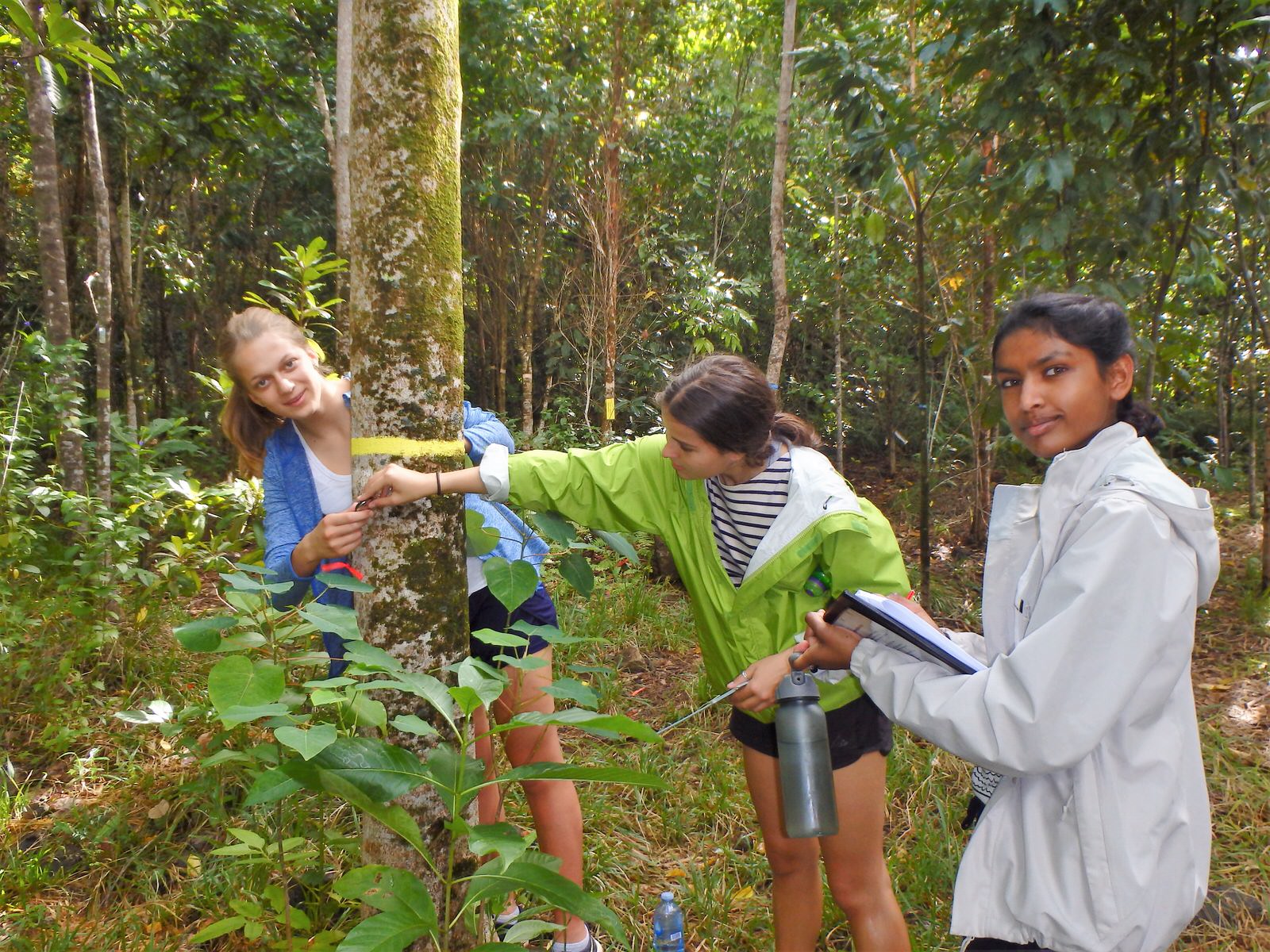
Students then complete a stratified transect survey along a permanent transect spanning three habitat types: revegetation zones, remnant forest, and old-growth rainforest. Using pre-established quadrats with labelled indicator plant species, students collect quantitative data on abiotic factors including soil pH, soil moisture, electrical conductivity, air temperature, relative humidity, and light availability. These measurements are used to classify each quadrat and analyse how vegetation structure, species composition, and biodiversity change across habitats. Students also record diameter at breast height (DBH) for representative trees and conduct plant health assessments, such as estimating leaf condition, providing insight into ecosystem condition and forest health—key skills in biological fieldwork.
Water Quality Measurements:
With guidance, students investigate freshwater ecosystem health by measuring pH, nitrate, and phosphate levels in nearby water bodies. These indicators help identify nutrient inputs, potential fertiliser runoff, and biological extremes, supporting discussion of species tolerance, water quality, and eutrophication processes. Students interpret how water chemistry influences organism survival and ecosystem function, linking terrestrial and aquatic systems.
Future of the Reef Talk:
In the evening, back in Cairns, students attend an engaging presentation on the future of the Great Barrier Reef. Led by a marine naturalist, the session examines the current condition of the reef, addresses misconceptions about coral bleaching and climate change, and evaluates the impacts of reef tourism. Students explore the four major threats to reef ecosystems and learn how scientists are trialling assisted evolution, breeding corals with increased tolerance to rising ocean temperatures. The session concludes with practical actions students can take to support reef conservation, reinforcing links between biological knowledge, stewardship, and global citizenship.
Accommodation: Cairns 3-star hotel
Meals included: Breakfast, Lunch and Dinner

Boat Ride to Reef:
This morning you travel aboard an air-conditioned vessel to a floating pontoon on the Great Barrier Reef, one of the world’s most significant marine ecosystems and a UNESCO World Heritage Area. On arrival, your marine biologist introduces the diversity of reef organisms you may encounter and explains the Eye on the Reef program. Through hands-on instruction, students learn how to conduct a Rapid Monitoring Survey, a nationally recognised citizen science method used to assess reef condition. This experience develops practical skills in ecological monitoring, data collection, and conservation biology, while highlighting the role science plays in reef protection and management.
Citizen Science Data Collection & Species & Predator Identification:
Under the guidance of your marine biologist, students participate in a timed snorkel survey, recording observations using waterproof data slates. You identify reef organisms, estimate benthic zone coverage, and record the presence of coral bleaching and coral predators—key indicators of reef health. Collected data is submitted to the central reporting system used by the Great Barrier Reef Marine Park Authority (GBRMPA), contributing directly to long-term reef monitoring, management, and conservation planning.
At midday, you enjoy a generous buffet lunch with a range of hot and cold options.
Pontoon Activities:
Back at the pontoon, students continue their reef investigations through immersive learning experiences including a semi-submarine, glass-bottom boat, and underwater observatory. These activities enhance understanding of marine ecosystems, trophic interactions, and species diversity without entering the water. Guided by your marine biologist, students examine how monitoring small reef organisms can help forecast outbreaks of Crown-of-Thorns starfish (COTS)—a coral predator linked to nutrient runoff and climate-related stress. Students learn about current scientific research, targeted intervention strategies, and reef restoration initiatives, including efforts to stabilise and rehabilitate cyclone-damaged coral habitats, demonstrating examples of human-induced environmental modification used to support ecosystem recovery.
Cairns Night Markets:
Returning to Cairns in the evening, students have the opportunity to explore the Cairns Night Markets, rounding out a day of applied marine biology and real-world conservation learning.
Accommodation: Cairns 3-star hotel
Meals Included: Breakfast and Lunch

After breakfast this morning you have free time for last-minute shopping or souvenir purchases.
Optional Community Service Project:
Part of being a “sustainable” tourist is helping the community in which you are travelling. This morning you exemplify sustainable tourists by participating in a service project for people that come to Cairns from remote Indigenous communities. These people come to Cairns for medical reasons, and often do not have anything with them. You learn to make special bags using upcycled materials, and then create packs with hygiene items they most need. No worries if you aren’t the best at arts and crafts – the bags are easy to make, and you’ll feel good doing it too. (Alow 1 hour; add $20 per person)
Later you are transferred to the Cairns airport for your flight home.
Meals included: Breakfast
Want to make this camp shorter or longer – custom tours are our speciality! Ask us how we can make this the perfect trip for your student excursion.


How Your Trip Makes The World A Better Place
We’re not talking rainbows and unicorns. We’re talking about how we have put significant thought into how to make our student tours as safe as they possibly can be while still being fun; encouraging students to learn about and contribute to the community they are travelling in; and teaching them what “sustainability” really means.

Sustainability
OUR COMMITMENT: OUR COMMITMENT: We are determined to operate as sustainably as possible. That’s why our office runs on renewable energy, we make annual contributions to climate‑focused initiatives, and we uphold our policy of donating at least 5% of our annual net profits to local environmental and community organisations and charities. Here’s what else we are doing:
HELPING THE REEF: For every group that visits the reef, we make a donation to the Reef Restoration Foundation (now re-named Resilient Reefs) to support their "Care for a Coral" program. The coral propagation work led by Resilient Reefs is groundbreaking and recognised as a major initiative in efforts to help restore the reef. Each group receives a "Care for a Coral" certificate from Resilient Reefs as a token of our contribution and commitment to reef conservation.
ADOPTING A RAINFOREST PLOT IN YOUR NAME: For each group that visits the rainforest, we contribute to the not-for-profit organisation Reforest to support the planting and nurturing of a tree, helping to regenerate the endangered Mabi rainforest. As part of your excursion, your group will receive a certificate recognising this meaningful gift to the environment...
...
Community
SUPPORTING OUR INDIGENOUS COMMUNITY: It is our policy to include a talk or an activity with an Aboriginal person on every trip we offer. By taking this trip, you are supporting grassroots Indigenous tourism ventures and encouraging Aboriginal pride in culture.Additionally, our student community service project involves students in making “Moon Sick Care Bags” which supply re-usable sanitary products to Aboriginal women in remote communities — this helps both Indigenous women AND the environment! (Ask us how your group can do this on their tour)
SUPPORTING LOCAL BUSINESSES: It is our policy to use locally owned suppliers and businesses unless their standards are not up to par (for example, if they have a bad environmental record).
VOLUNTEERING IN OUR COMMUNITY: Small World staff are incentivised to volunteer in the community...

Safety
SUPERB SAFETY RECORD: Small World Journeys has safely hosted thousands of Australian high school students on educational excursions across Australia. We are proud of our excellent safety record and are happy to provide teacher references specifically addressing student safety and risk management on request.
RISK ASSESSMENT FOR EVERY TRIP: A comprehensive risk assessment is completed for every school excursion and provided to the organising teacher prior to departure. All activities operate under documented safety protocols outlined in our Standard Operating Procedure (SOP) Manual, supported by a detailed Crisis Management Plan. In addition, all students receive a mandatory safety briefing during orientation, addressing regional hazards, environmental risks, and expected behaviours relevant to Far North Queensland.
SAFE BUSES: All vehicles used on our student excursions are fitted with seatbelts for every passenger, exceeding Queensland legal requirements because student safety is our priority. Our guides conduct daily vehicle safety checks, and all buses undergo Department of Transport safety inspections every 12 months, ensuring compliance with national transport standards.

We do custom trips!
Still haven’t found exactly what you are looking for? All our tours are fully customisable and can be catered to suit your time-frame, student interests and budget. A geography excursion to the Great Barrier Reef? A biology excursion to the Daintree Rainforest? An Aboriginal culture excursion? Our educational trips in Queensland and New South Wales are hand-crafted for those who cannot find exactly what they want from the inflexible set itineraries of large tour operators.
If you are looking for a science trip, ecology trip, Aboriginal culture, or just a sample of the best of Australia – we can help.